Why AI Could Make Live Experiences More Valuable, Not Less
TicketSocket | The Future of Live Entertainment & Event Commerce
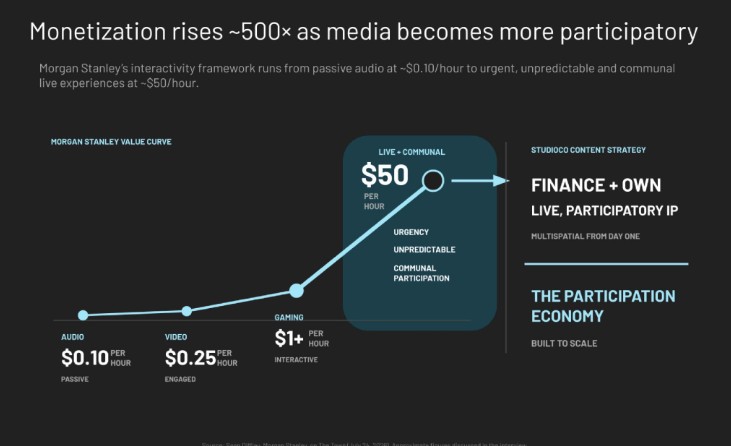
Morgan Stanley’s interactivity framework: monetization rises sharply as media becomes more participatory.
If AI creates more leisure time, who will win—and monetize—those additional entertainment hours?
That question may become one of the defining business questions of the next decade.
Artificial intelligence is rapidly reducing the time required to write, design, analyze, code, communicate and create. At the same time, generative AI is dramatically increasing the amount of digital content available to consumers.
The natural assumption is that AI will primarily benefit digital entertainment.
We believe something bigger may happen.
As digital content becomes abundant, human participation becomes scarce.
And scarcity creates value.
At TicketSocket, we call this emerging category the Participation Economy: the part of the entertainment economy built around experiences people don’t simply watch or consume—they attend, participate in, share and experience together.
Concerts. Festivals. Sporting events. Races. Attractions. Immersive entertainment. Competitive events. Fan experiences. Conferences. Cultural gatherings.
These are experiences where the customer doesn’t just consume the product. The customer becomes part of the product.
The Economics of Participation
A recent episode of The Town with Matt Belloni featuring Sean Diffley, Morgan Stanley’s Head of Media & Entertainment Research, provided an interesting financial framework for thinking about this shift.
The framework compares entertainment categories by their approximate ability to monetize an hour of consumer attention:
- Audio: ~$0.10 per hour
- Video: ~$0.25 per hour
- Gaming: $1+ per hour
- Live + communal experiences: ~$50 per hour
The direction of the curve is striking. As entertainment moves from passive → engaged → interactive → participatory, monetization per hour can increase dramatically.
At roughly $50 versus $0.25 per entertainment hour, live experiences can represent approximately 200× the monetization of video entertainment on an hourly basis.
Compared with passive audio, the difference approaches 500×.
The implication isn’t that live entertainment will replace Netflix, Spotify, YouTube or AI-generated entertainment. It’s that an hour spent participating in the physical world can be economically far more valuable than another hour spent consuming an infinitely available digital feed.
AI Is About to Make Content Abundant
Generative AI changes the economics of media because the marginal cost of creating content is falling.
Soon, virtually anyone will be able to generate high-quality video, music, games, imagery and personalized entertainment. There will be more content than any person could possibly consume.
That creates a paradox: the more digital content we create, the harder it becomes for any individual piece of digital content to remain scarce.
But you cannot infinitely generate another front-row seat. You cannot duplicate the atmosphere inside a stadium during a championship. You cannot manufacture unlimited finish-line moments at a marathon. You cannot reproduce the exact crowd, weather, competitors, artists, friends and emotions surrounding a live experience.
AI can create another video. It cannot create another seat in a sold-out venue.
That distinction could become increasingly important.
The Most Valuable Entertainment May Be the Entertainment You Participate In
Interactivity creates value. The consumer has agency. They attend, compete, cheer, dance, explore, meet people and influence the experience.
Urgency creates value. A live event happens at a particular place and time. Missing it matters.
Unpredictability creates value. Nobody knows exactly how a game, race, concert or festival will unfold.
Community creates value. Thousands of people experiencing something together creates an emotional intensity that on-demand media struggles to replicate.
Scarcity creates pricing power. There may be millions of copies of a digital movie. There are only so many tickets to Saturday night’s championship.
AI Could Actually Expand the Participation Economy
There is another side of the AI story that gets less attention. AI doesn’t only create more content. AI could create more time.
If AI makes workers significantly more productive, tasks that previously required eight hours may eventually require six—or four.
That creates an enormous economic question: Where does the additional leisure time go?
Some of it will undoubtedly flow toward streaming, gaming, social media and AI-generated entertainment. But humans are social creatures.
The more time we spend interacting with machines and digital environments, the more valuable authentic human experiences may become.
People will still want to travel. They will still want to attend concerts. They will still want to watch their teams play. They will still want to race, compete, celebrate, explore and gather.
In fact, AI-driven productivity could increase both the time and disposable income available for those experiences.
That makes live entertainment one of the more interesting potential beneficiaries of the AI economy.
Ticketing Sits at the Transaction Layer of the Participation Economy
This is where the thesis becomes particularly important for TicketSocket.
Ticketing isn’t simply software used to issue a QR code. Ticketing is the commerce infrastructure connecting consumers to participatory experiences.
Every time someone decides, “I want to be there,” a transaction happens.
The ticketing platform sits at that moment.
And the opportunity increasingly extends beyond the initial ticket: premium experiences, parking, merchandise, food and beverage, upgrades, memberships, VIP packages, sponsorship activation and other forms of event commerce can all surround that original decision to participate.
That makes ticketing part of something much larger than the traditional “ticketing industry.” It is infrastructure for the Participation Economy.
Why We Believe This Makes Ticketing More Defensible in an AI World
AI will absolutely change ticketing.
At TicketSocket, we expect AI to become deeply embedded in how events are marketed, priced, operated, supported and analyzed.
But there is an important distinction between AI disrupting the infrastructure of an industry and AI eliminating the underlying demand for that industry.
AI can write marketing copy. AI can create advertising creative. AI can optimize pricing. AI can improve customer support. AI can help predict demand. AI can make event operators dramatically more efficient.
But AI doesn’t eliminate the fundamental transaction: a human being purchasing access to a scarce experience involving other human beings.
In many ways, AI may strengthen that transaction.
As digital creation becomes easier, differentiation shifts toward the things that remain difficult to reproduce: presence, community, scarcity, identity, access and participation.
Those are precisely the characteristics that live experiences monetize.
From the Attention Economy to the Participation Economy
For the last two decades, technology companies competed aggressively for attention: views, clicks, streams, minutes watched and engagement.
The next major entertainment economy may compete for something more valuable: participation.
The difference matters.
The Attention Economy asks: How much of someone’s time can we capture?
The Participation Economy asks: How valuable can we make the time someone chooses to spend with us?
Morgan Stanley’s monetization curve provides an interesting way to quantify that distinction: approximately $0.10 per hour for passive audio, approximately $0.25 for video, more than $1 for interactive gaming, and potentially around $50 per hour for highly participatory, communal live experiences.
That isn’t merely an incremental increase. It is a fundamentally different economic model for entertainment.
TicketSocket Is Building for That Economy
TicketSocket’s mission has always extended beyond selling tickets.
We provide event operators, venues, attractions, festivals, races and entertainment brands with the infrastructure to own their audience, control their brand, manage their commerce and build direct relationships with their customers.
That becomes increasingly important in the Participation Economy.
The companies that create the experience should have the ability to own the customer relationship surrounding it.
And as AI makes passive content increasingly abundant, we believe the value of scarce, participatory experiences—and the technology powering those experiences—has the potential to increase.
AI may create more content than humanity has ever seen. It may also create more leisure time than modern consumers have ever had.
The question is where those hours will go.
We believe a meaningful portion will move from consumption to participation.
And if that happens, the businesses powering the Participation Economy could be positioned at one of the most valuable intersections of technology, commerce and entertainment.
Welcome to the Participation Economy.
Source note: Monetization-per-hour figures referenced above are approximate figures discussed by Sean Diffley of Morgan Stanley on the July 24, 2026 episode of The Town with Matt Belloni. The “Participation Economy” framing and its application to ticketing and event commerce reflect TicketSocket’s strategic thesis.